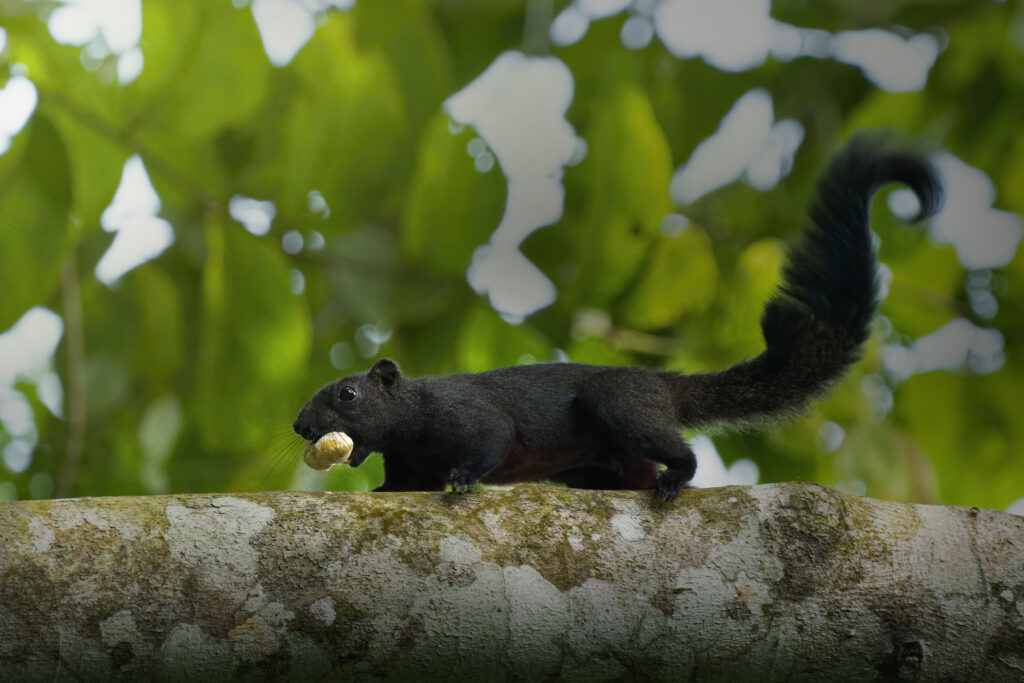

Darting across tree trunks like a shadow, the Black Squirrel often surprises observers with its bold appearance. Sleek, mysterious, and strikingly different from its grey or brown relatives, the black squirrel is not a separate species—but a fascinating natural variation that adds intrigue to forests, parks, and urban landscapes.
What Is a Black Squirrel?
A black squirrel is a melanistic colour morph of certain squirrel species, most commonly:
- Eastern Grey Squirrel (Sciurus carolinensis)
- Fox Squirrel (Sciurus niger)
Melanism is a genetic trait that causes an excess of dark pigmentation, resulting in fur that appears black or very dark brown.
Physical Appearance
Black squirrels share the same body structure as their non-black counterparts but stand out due to their colour:
- Jet black or dark chocolate-brown fur
- Bushy tail often with frosted tips
- Sharp claws for climbing
- Bright, alert eyes
Their dark fur can sometimes show brown or rusty highlights in strong sunlight.
Habitat and Distribution
Black squirrels are found in:
- Forests and woodlands
- City parks and gardens
- University campuses
- Suburban neighborhoods
They are especially common in North America, particularly in colder regions, where their dark fur provides survival advantages.
Why Are Some Squirrels Black?
The dark colouration offers several benefits:
- Better heat absorption in cold climates
- Improved camouflage in dense forests
- Possible resistance to certain diseases
In colder environments, black squirrels may survive winter conditions better than lighter-colored squirrels. There are some other types of squirrels, such as the Indian Palm Squirrel and the Indian Giant Squirrel.
Diet and Feeding Habits
Black squirrels have the same diet as other tree squirrels and are omnivorous, feeding on:
- Nuts and seeds
- Fruits and berries
- Tree buds and bark
- Insects and bird eggs (occasionally)
They are well-known for storing food to survive harsh seasons.
Behaviour and Lifestyle
- Active during daylight hours
- Highly intelligent and cautious
- Excellent climbers and jumpers
- Communicate through tail flicks and vocal sounds
Black squirrels are territorial but often tolerate others when food is abundant.
Breeding and Life Cycle
Breeding usually occurs once or twice a year. Females give birth to 2–4 young in well-hidden nests made of leaves and twigs. Young squirrels depend on their mother for several weeks before becoming independent.
Ecological Importance
Black squirrels play a vital role in ecosystems by:
- Dispersing seeds
- Supporting forest regeneration
- Serving as prey for larger animals
Their presence contributes to healthy and balanced woodland environments.
Conservation Status
Black squirrels are not endangered. Since they are colour variants of common squirrel species, their populations remain stable. However, habitat loss and road traffic pose ongoing risks.
Why Black Squirrels Fascinate People
- Rare and eye-catching appearance
- Easy to observe in urban settings
- Popular subject for wildlife photography
- Example of natural genetic diversity
Final Thoughts
The black squirrel is proof that nature loves variety. Though often overlooked as “just another squirrel,” its dark coat tells a story of genetics, adaptation, and survival. Whether seen racing across a park lawn or perched silently on a branch, the black squirrel adds mystery and beauty to everyday wildlife encounters.