
The Blossom-headed Parakeet (Psittacula roseata) is one of the most elegant and softly colored parakeets found in South and Southeast Asia. With its delicate pink head, graceful flight, and calm personality, this species stands out among Asian parrots.
Often seen perched quietly on treetops or flying swiftly across forest edges, the Blossom-headed Parakeet is a favourite among birdwatchers and wildlife photographers.
Blossom-headed Parakeet Identification and Appearance
The Blossom-headed Parakeet is a medium-sized parrot known for its subtle yet striking colouration.
Key Identification Features:
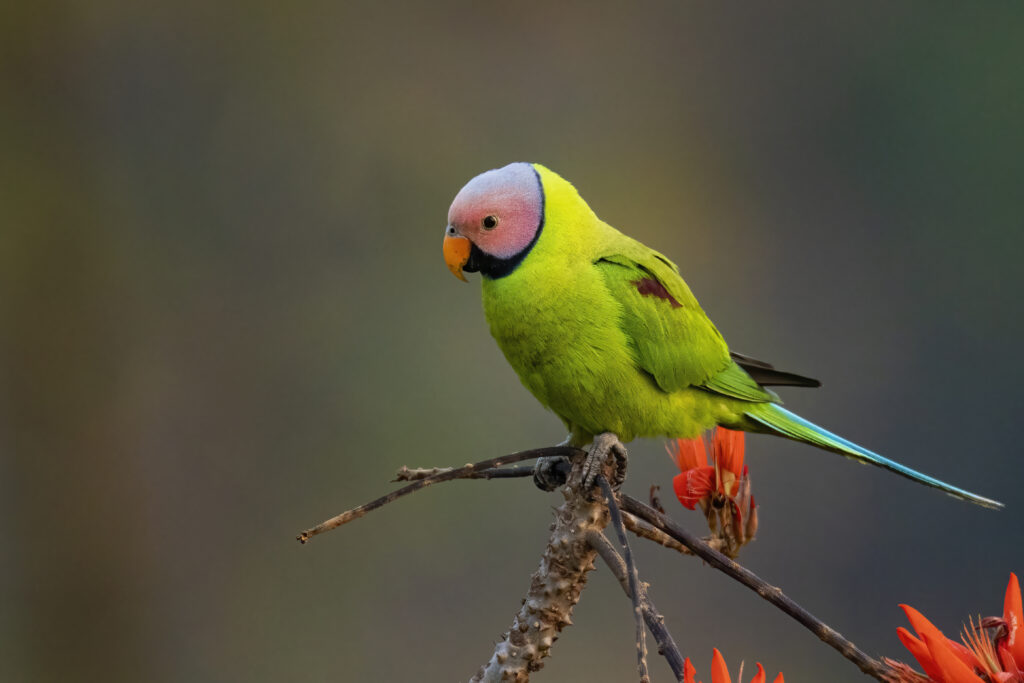
- 🌸 Head (Male): Soft pink to lilac crown
- 🟢 Body: Bright green plumage
- 🖤 Neck Ring (Male): Thin black collar with bluish tinge
- 🔵 Tail: Long bluish tail with yellow underside
- 🔴 Beak: Pale yellow upper mandible, darker lower mandible
Sexual Dimorphism
Males have the distinctive pink head and defined neck ring.
Females have a bluish-grey head instead of pink and lack the bold collar.
Average length: 30–33 cm (including tail)
Habitat and Distribution of the Blossom-headed Parakeet
The Blossom-headed Parakeet is native to:
- Bangladesh
- India (northeast regions)
- Myanmar
- Thailand
- Laos
- Vietnam
- Southern China
Preferred Habitats
- Open forests
- Forest edges
- Bamboo groves
- Woodland near rivers
- Lightly wooded agricultural areas
In Bangladesh, they are mostly found in forested and semi-forested regions where mature trees provide nesting cavities.
Behaviour and Social Structure
The Blossom-headed Parakeet is generally quieter compared to other parakeets. However, during flight, it produces sharp, high-pitched calls.
Behavioural Highlights:
- Usually seen in pairs or small flocks
- Fast, direct flight pattern
- Strong pair bonding
- Less aggressive than Rose-ringed or Alexandrine Parakeets
They are often shy and may stay high in the canopy, making photography slightly challenging but rewarding.
Diet and Feeding Habits
The Blossom-headed feeds mainly on:
- Wild fruits
- Seeds
- Berries
- Flower buds
- Tender shoots
They also visit cultivated fields occasionally but are less notorious crop raiders than larger parakeet species.
Breeding and Nesting
- Breeding Season: February to May
- Nest Type: Tree cavities in mature trees
- Clutch Size: 3–4 eggs
- Incubation: Around 22–24 days
Both parents participate in raising the chicks. Old trees play a critical role in their breeding success.
Conservation Status
According to the IUCN Red List, the Blossom-headed Parakeet is currently classified as:
🟢 Least Concern (LC)
However, local populations face pressure due to:
- Habitat destruction
- Logging of old trees
- Illegal trapping for the pet trade
Protecting forest ecosystems is essential for maintaining stable populations.
Photography Tips for Capturing Pink-headed parakeet 📸
If you’re photographing the Blossom-headed Parakeet:
- Use a 400mm or longer lens
- Shoot during early morning light
- Focus on fruiting trees
- Wait patiently for canopy-level movement
- Capture a side profile to highlight the pink crown
The soft pastel tones of the male make it particularly photogenic in natural light.
Interesting Facts About the Parakeet
✨ The pink head resembles flower petals — hence the name
✨ Females and males look noticeably different
✨ Less vocal compared to many parakeet species
✨ Prefers quieter forest environments
Why the Blossom-headed Matters
The Parakeet is more than just a beautiful bird. It represents the delicate balance of forest ecosystems in Asia. Because it depends on mature trees for nesting, its presence indicates healthy woodland habitats.
For wildlife photographers and conservation enthusiasts, spotting this species is always a special experience.