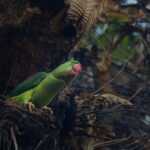
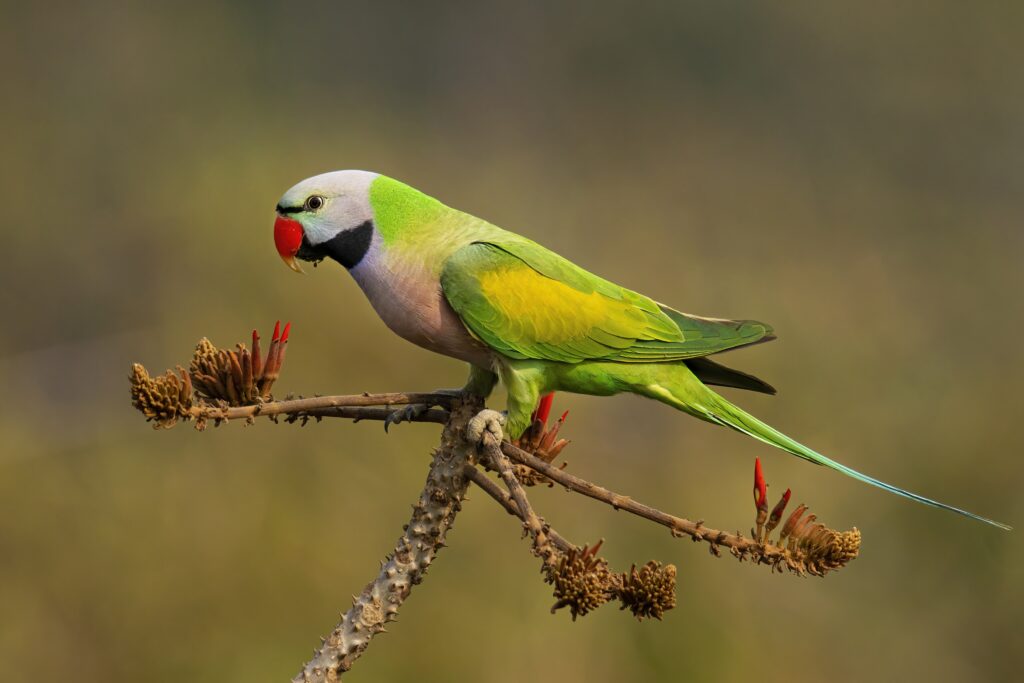

The Red-breasted Parakeet (Psittacula alexandri), also known as the Moustached Parakeet, is one of the most striking parakeet species found across South and Southeast Asia. With its vivid plumage, intelligent behaviour, and lively calls, this bird is a true delight for birdwatchers and wildlife photographers alike.
Scientific Classification
- Common Name: Red-breasted Parakeet
- Scientific Name: Psittacula alexandri
- Family: Psittaculidae
- Order: Psittaciformes
Identification & Physical Appearance
The Red-breasted Parakeet is a medium-sized parrot, easily recognisable by its bold colours and elegant posture.
Key Features:
- Breast: Distinctive rose-pink to reddish breast (more prominent in males)
- Head: Greyish-blue crown with a darker chin band
- Back & Wings: Rich green with a subtle bluish sheen
- Beak: Bright red upper mandible with a darker lower mandible
- Tail: Long, pointed, and bluish-green
🔍 Sexual Dimorphism:
Males display brighter chest colouration and a clearer facial band, while females appear slightly duller with softer markings.
Habitat & Distribution
The Red-breasted Parakeet is widely distributed across:
- South Asia: India, Bangladesh, Sri Lanka
- Southeast Asia: Myanmar, Thailand, Cambodia, Vietnam, Malaysia
- Southern China & Indonesia
Preferred Habitats:
- Tropical and subtropical forests
- Open woodlands
- Mangroves and forest edges
- Urban parks and gardens near wooded areas
In Bangladesh, this species can occasionally be seen in forested zones and large green spaces, especially where fruiting trees are abundant.
Behavior & Ecology
Highly social and intelligent, Red-breasted Parakeets are usually found in pairs or small flocks.
Behavioural Traits:
- Strong, fast flight with sharp wingbeats
- Loud, metallic calls while in flight
- Curious and alert nature
- Strong bonding between mating pairs
They are most active during early morning and late afternoon—perfect times for photographers 📷.
Diet & Feeding Habits
The Red-breasted Parakeet is primarily herbivorous, feeding on:
- Fruits and berries
- Seeds and grains
- Buds and blossoms
- Cultivated crops (occasionally)
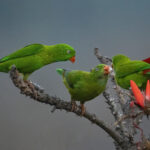
Their strong beak allows them to crack hard seeds with ease, making them skilled foragers in both wild and semi-urban environments. Similar kinds of diet & feeding habits of the Vernal Hanging Parrot.
Breeding & Nesting
- Breeding Season: Typically from December to April
- Nesting Sites: Natural tree cavities, often reused yearly
- Clutch Size: 2–4 eggs
- Parental Care: Both parents participate in feeding and protecting chicks
The bonding between pairs is strong, often lasting for several breeding seasons.
Conservation Status
According to the IUCN Red List, the Red-breasted Parakeet is currently classified as:
🟢 Least Concern (LC)
Threats Include:
- Habitat loss due to deforestation
- Illegal trapping for the pet trade
- Decline of old trees used for nesting
Conservation of mature forests and legal protection are essential to ensure long-term survival.
Photography Tips for Wildlife Enthusiasts 📸
- Use a telephoto lens (300mm–500mm) to capture natural behaviour
- Focus on early morning light for soft colours
- Look near fruiting trees for feeding shots
- Capture flight shots during flock movement
Their colourful breast and expressive face make them ideal subjects for storytelling wildlife photography.
Interesting Facts
✨ Also known as the Moustached Parakeet due to its dark facial markings
✨ Capable of mimicking sounds in captivity
✨ Known for strong pair bonds
✨ One of the more colourful members of the Psittacula genus
Final Thoughts
The Red-breasted Parakeet is not just a colourful bird—it’s a symbol of Asia’s rich biodiversity. Its vibrant appearance, intelligent behaviour, and adaptability make it a favourite among bird lovers and photographers. Protecting its habitat ensures that future generations can continue to enjoy this beautiful parrot in its natural habitat.